
Why Protestants shouldn’t celebrate Halloween
Here’s what the Reformation means for the spooky holiday

The Irony and the Origins
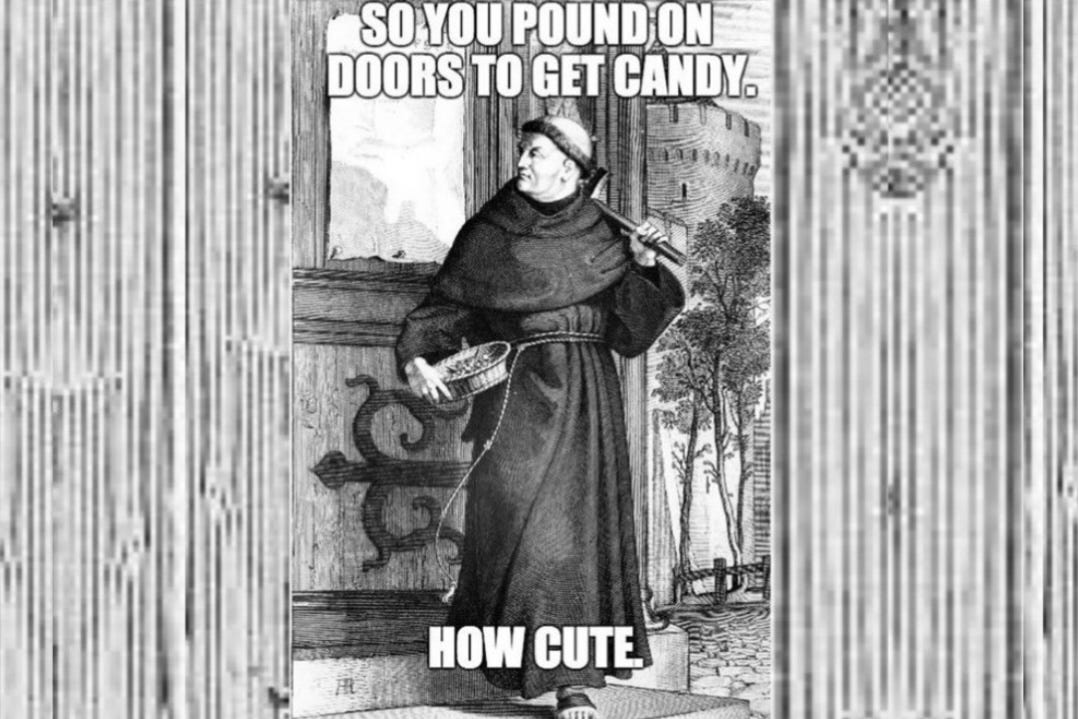
Five hundred eight years ago today, on December 31, 1517, Martin Luther pounded his ninety-five theses to the door of the Wittenberg Castle Church in Germany in an effort to challenge heretical traditions. These days, on the same day of the year, people dress up and pound on doors for candy, or pass candy out, in adherence to pagan and heretical traditions—albeit a sanitized version of them. Here’s the history, and what Christians should do about it.
The history of Halloween (as of many modern holidays) is too little understood by most of those who celebrate it. The holiday is traced back to the ancient Celtic pagan festival called Samhain (pronounced SAH-win), which marked the end of the harvest season. During this time, the Celts believed that the veil between the living and the dead was at its thinnest, and thus spirits were expected to visit. The pagans, therefore, left out food as a service to welcome spirits, and disguised themselves to avoid unwelcome ones—a false hope.
As Christianity spread, some popular strains unfortunately adopted and adapted these practices, and made it into a day for the dead. In 835, Emperor Louis the Pious decreed All Saints’ Day (or All Hallows’ Day) on November 1. The night before came to be observed as a vigil called All Hallows’ Eve (or Halloween).
In those Medieval days, the poor would put on costumes and go to homes of the wealthy, offering to pray for their deceased loved ones in exchange for gifts. The belief was, the more prayers for a dead person, the more likely that the dead person would be saved from purgatory—a false gospel.
The Reformation and the Amalgamation
The Reformation that Luther started was remarkably relevant to these beliefs and practices. It restored the public understanding that no one can do anything to save themselves or anyone else. Only God, by grace and through our faith in Jesus, can do that, because Jesus’ death paid the penalty for the sins of those who believe in Him, and His resurrection secured the hope of new life.
Article continues below

Today, Halloween is an amalgamation of the macabre and the cute. On the one hand, it’s an open display of a resurgent cultural fascination with the occult. In fact, in modern occultism, like ancient paganism, it’s believed to be the day when the veil between the living and the dead is the thinnest—a day for practicing witchcraft.
On the other hand, there is a strong emphasis on children, as the most common way of celebrating is to dress up and go trick-or-treating. Many churches join in by hosting fall festivals or “trunk-or-treat” events, considering these to be Christian alternatives, despite involving the same activities such as dressing up and handing out treats.
As different as those two aspects of the holiday may seem, it’s simple enough to see that it’s all connected, historically, thematically, and spiritually. In fact, the stark difference between these two aspects should be alarming: there’s something off about a night of horror that is also a night for children. That’s just the kind of thing Satan would like, isn't it? It’s worth noting, as many have, that Anton LaVey, founder of the Church of Satan, is quoted as saying, “I am glad that Christian parents let their children worship the devil at least one night out of the year.”
His assessment is not far off. From pro-life-approved abortions to cross-sex hormones and transgender surgeries on minors, to the myriad devastating lies taught in schools—secular humanism, cultural Marxism, sexual perversions, and beyond—Satan is on a warpath to steal, kill, and destroy children. Is Halloween just another tactic in the enemy’s war on our young, making a mockery of childhood innocence and easing them into a fondness for traditions based in darkness? Are you or your church combating the enemy on this front, or giving him ground? How can Christians, for the gospel’s sake, take advantage of the world’s attention to spiritual things on Halloween without adopting and adapting ancient pagan practices?
The Conclusion
We still need reformation. We can promote it in small ways, such as not trick-or-treating, not handing out candy, and not throwing fall festivals—but instead sharing the gospel in creative and winsome ways that don’t involve buying into traditions with wicked origins and that make us seem like everybody else. If we even start playing the world’s game, we’ve already lost it.
Would this offend some people? Yes, and so did Luther. Otherwise, he wouldn’t have done any good for the Kingdom.
Anthony Langer | Theologiculture
